How Many Boxes Do I Need to Move House?
Move Cost Calculator Team
content compiled from credible research to provide accurate, reliable information.
Quick Answer| Last updated: May 2026
On average, a 1-bedroom flat needs 30-45 boxes, a 2-bedroom house needs 45-70, and a 3-bedroom house requires 70-95 boxes. Always buy 10% more than you think you'll need.
A comprehensive guide to estimating the number of moving boxes you need based on property size and how long you've lived there.
Key Takeaways
- •Plan Early: Start planning your move at least 6-8 weeks in advance to secure the best dates and rates.
- •Compare Quotes: Always compare at least 3 local removal quotes to ensure you get a fair market price.
- •Declutter: Reducing the volume of your belongings is the most effective way to lower your moving costs.
Want a quick estimate before you read the full guide?
Use our moving cost calculator →One of the most common, stressful, and frequently miscalculated questions people ask when preparing for a home move in the UK is: "How many boxes do I actually need to move house?" Getting this right is absolutely crucial to the success of your entire moving operation. Underestimating means panic-buying expensive boxes at the last minute, throwing items into weak bin bags, or delaying your removal company. Conversely, overestimating wastes your hard-earned money and clutters up your current space with empty cardboard before you even begin packing.
In this comprehensive, in-depth guide, we will break down exactly how many boxes you need based on property size, room type, lifestyle, and how long you have lived in your home. We will also cover the different types of boxes available, essential packing materials, where to source them, professional packing strategies, and how to avoid the most common packing mistakes that lead to broken belongings and moving day disasters. By the end of this guide, you will have a clear, actionable plan for ordering your packing supplies.
The Short Answer: Average Box Requirements by Property Size
While every single home is unique and every family has vastly different amounts of belongings, having a reliable baseline is essential for initial planning. Here is a realistic, professional-grade estimate of the number of boxes needed based on property size in the UK. This table serves as a starting point before you adjust for your specific lifestyle factors.
| Property Size | Small/Medium Boxes | Large Boxes | Wardrobe Boxes | Total Estimated Boxes |
|---|---|---|---|---|
| 1-Bedroom Flat | 15 - 20 | 5 - 10 | 1 - 2 | 20 - 32 |
| 2-Bedroom House/Flat | 25 - 35 | 10 - 15 | 2 - 3 | 37 - 53 |
| 3-Bedroom House | 35 - 50 | 15 - 25 | 3 - 4 | 53 - 79 |
| 4-Bedroom House | 50 - 70 | 25 - 35 | 4 - 6 | 79 - 111 |
| 5+ Bedroom House | 70 - 100+ | 35 - 50+ | 6 - 8+ | 111 - 158+ |
Important Note: The table above assumes an average lifestyle, a typical amount of furniture, and a standard accumulation of belongings. If you are a strict minimalist, you might lean towards the lower end of these ranges. If you have lived in your property for decades, have extensive collections, or utilize every inch of loft space, you will likely need the higher end or even more.
Detailed Room-by-Room Box Breakdown
To get a truly accurate estimate of how many boxes you need, it is highly recommended to evaluate your home room by room. Different rooms have vastly different packing requirements. A kitchen, for example, requires many more boxes than a spare bedroom due to the sheer volume of individual, fragile, and oddly shaped items. Let's break down the typical box requirements for each area of your home.
1. The Kitchen (10 - 25 Boxes)
The kitchen is notoriously the most difficult, tedious, and time-consuming room to pack. It contains a massive variety of items, from heavy cast-iron pots and pans to delicate wine glasses, oddly shaped appliances, and pantry food. It often takes a full day just to pack a standard family kitchen.
- Small/Medium Boxes (6-15): Essential for heavy items like canned goods, cookbooks, heavy pots, and dense stacks of everyday plates. Remember, small boxes are for heavy items!
- Large Boxes (4-8): Used exclusively for lightweight, bulky items like plastic Tupperware containers, large mixing bowls, baking trays, and light appliances (e.g., air fryers, toasters, blenders).
- Dish Barrel / Fragile Boxes (1-3): Highly recommended. These are double-walled, extra-strong boxes specifically designed with cellular dividers for fragile plates, glasses, and mugs.
2. The Living Room (10 - 20 Boxes)
Living rooms vary wildly depending on your lifestyle. If you have large bookshelves, extensive DVD/vinyl collections, or numerous fragile decorative ornaments, your box count will skyrocket compared to someone with a minimalist setup and a wall-mounted TV.
- Small Boxes (4-10): Crucial for books. Books are incredibly heavy when packed together. Never pack books in large boxes, or the box will break and be impossible to lift safely.
- Medium Boxes (4-6): Good for ornaments, photo frames, electronics, small lamps, and board games.
- Large Boxes (2-4): Perfect for cushions, throw blankets, lampshades, and soft furnishings.
3. The Master Bedroom (10 - 15 Boxes)
The master bedroom requires a mix of box sizes, heavily dependent on the size of your wardrobe and whether you are a bit of a fashion enthusiast.
- Wardrobe Boxes (2-4): These are tall boxes with a hanging rail inside. You can transfer clothes directly from your real wardrobe to the box on their hangers, saving hours of folding and ironing. They are a massive time-saver.
- Medium Boxes (5-8): Used for folded clothes, shoes, books, bedside table contents, and personal items.
- Large Boxes (3-5): Ideal for bedding, duvets, pillows, and large bulky winter sweaters.
4. Additional Bedrooms / Kids Rooms (8 - 15 Boxes per room)
Spare rooms often double as hidden storage spaces, while children's rooms are usually filled with toys that take up surprising amounts of volume, even if they aren't particularly heavy.
- Medium Boxes (5-10): For toys, books, folded clothes, school supplies, and general items.
- Large Boxes (3-5): For bulky plastic toys, bedding, soft toys, and playmats.
5. The Bathroom (2 - 5 Boxes)
Bathrooms are relatively easy to pack, but require special care to prevent disastrous leaks that can ruin other boxes.
- Small/Medium Boxes (2-5): For toiletries, medicines, towels, and cleaning supplies. Always tape the lids of liquid bottles shut and place them in sealed plastic ziplock bags before boxing them to prevent spills.
6. The Home Office / Study (8 - 15 Boxes)
If you work from home, the study is a critical room that requires careful organization.
- Small Boxes (4-8): For heavy books, reference materials, files, and dense paperwork.
- Medium Boxes (4-7): For office supplies, electronics, cables, desk accessories, and stationery.
- Archive Boxes: If you have extensive paperwork, consider proper archive boxes with built-in handles and lids for easy access and secure storage.
7. The Garage, Shed, and Loft (10 - 30+ Boxes)
These are the absolute danger zones of moving. People frequently forget to calculate boxes for these areas, yet they often contain years (or decades) of accumulated belongings, heavy tools, holiday decorations, and bulky equipment.
- Heavy-Duty Medium Boxes (10-20): Essential for heavy tools, paint cans, hardware, and gardening equipment. Standard boxes will easily break under the weight of garage items.
- Large Boxes (5-10): For camping gear, sports equipment, seasonal decorations, and bulky outdoor cushions.
The "Miscellaneous" Factor
Always add an extra 10-15% to your final box calculation. As you get closer to moving day, you will inevitably find items hidden in cupboards, under beds, in the airing cupboard, or behind furniture that you completely forgot about. Having spare boxes prevents last-minute panic and stressful dashes to the storage shop.
Understanding Different Types of Moving Boxes
Not all boxes are created equal. Using the wrong type of box for the wrong items is a recipe for disaster. Moving boxes need to be sturdy enough to be stacked on top of each other in a moving van without crushing the contents inside. Understanding the different types will help you pack like a professional.
1. Standard Small Boxes (Approx. 12" x 12" x 12")
Also known as "book boxes." These are your absolute workhorses for heavy items. Because they are small, you cannot overpack them to the point where they become too heavy to lift safely.
Best for: Books, CDs, vinyl records, canned food, heavy tools, cutlery, small heavy appliances, and dense items.
2. Standard Medium Boxes (Approx. 18" x 18" x 16")
The most versatile box size. You will use more of these than any other type of box. They offer a good balance between volume and weight capacity.
Best for: Pots and pans, toys, folded clothing, electronics, shoes, non-perishable food, and general household items.
3. Standard Large Boxes (Approx. 18" x 18" x 24")
Large boxes have a high volume but should only be used for lightweight items. If you fill a large box with books, it will weigh over 40kg, making it highly dangerous to lift and almost guaranteed to burst open from the bottom.
Best for: Bedding, pillows, cushions, towels, bulky winter coats, large plastic toys, lampshades, and lightweight bulky items.
4. Wardrobe Boxes
These are tall, sturdy boxes that include a metal or plastic hanging bar across the top. They act as portable wardrobes.
Best for: Suits, dresses, coats, delicate clothing, and anything you don't want to fold or iron. You can also utilize the empty space at the bottom of the box for lightweight items like shoes, belts, or small bags.
5. Dish Barrel / Fragile Boxes
These are heavy-duty, double-walled corrugated boxes designed specifically to absorb shock and protect fragile items. They often come with cellular dividers inside to keep items separate.
Best for: Plates, glasses, fine china, crystal, vases, delicate ornaments, and expensive fragile items.
6. Archive Boxes
Sturdy boxes with integrated handles and a separate lid, designed to hold standard A4 files and folders without bending them.
Best for: Important documents, home office files, tax records, personal paperwork, and items you need to access quickly without cutting tape.
Crucial Factors That Change Your Box Count
If you are trying to decide whether you need 30 boxes or 60 boxes for your 2-bedroom house, consider these critical lifestyle factors that dramatically impact the volume of your belongings:
1. How Long Have You Lived in the Property?
The longer you live somewhere, the more you accumulate. It's basic human nature. If you have lived in a 3-bedroom house for 2 years, you might need 40 boxes. If you have lived in the exact same house for 20 years, you might need 80 or 100 boxes. Decades of accumulated memories, loft storage, garage clutter, and forgotten cupboards add up significantly.
2. Are You a Minimalist or a Hoarder?
Be brutally honest with yourself. Does your home look like a minimalist showroom with clear surfaces and sparse cupboards? Or are your bookshelves overflowing, your wardrobes bursting, and every cupboard packed to the brim? A minimalist can often reduce their estimated box count by 20%, while a collector or someone with a cluttered home should increase it by at least 30%.
3. How Much Decluttering Will You Do?
Moving is the perfect time to declutter. If you are committed to a ruthless purge—donating to charity, selling items online, and throwing away rubbish—you will drastically reduce the number of boxes you need. If you plan to "just pack everything and sort it out at the new house," you will need maximum boxes (and you'll pay more for the removal company to transport items you don't even want).
4. Are You Packing Furniture Contents?
Remember that all furniture must be emptied before it can be moved. Chests of drawers, wardrobes, sideboards, kitchen cabinets, and bathroom vanities all contain items that need to go into boxes. The more storage furniture you have, the more boxes you need to empty them.
Need a Quick Estimate?
Stop guessing and use our interactive Packing Box Calculator. Just enter your property size and lifestyle, and we'll tell you exactly what to buy.
Open Packing Box CalculatorEssential Packing Materials (It's Not Just About Boxes)
Knowing how many boxes you need is only half the battle. To pack safely and securely, you need the right supporting materials. Without these, your boxes will burst, and your items will break. Never skimp on packing materials.
1. Packing Tape (The Most Important Item)
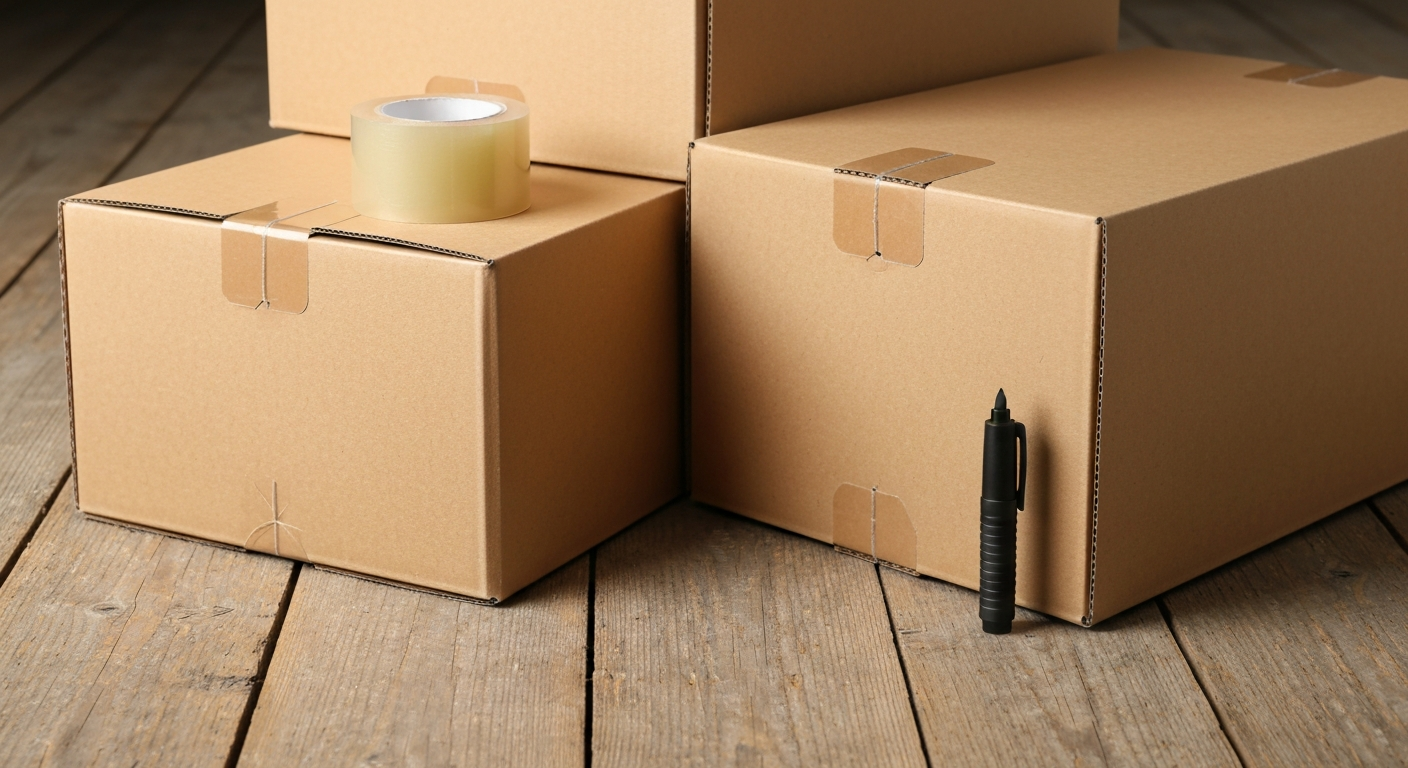
Do not use cheap, thin tape, masking tape, or duct tape. You need high-quality, strong, brown or clear acrylic packing tape (at least 48mm wide).
How much do you need? A good rule of thumb is 1 roll of tape for every 10-15 boxes. If you need 50 boxes, buy at least 4-5 rolls of tape. Always buy more than you think you need.
2. Tape Dispenser / Gun
Spend the £10-£15 on a proper tape dispenser gun. It will save you hours of frustration trying to find the end of the tape and will ensure a much tighter, more secure seal on your boxes. It is worth its weight in gold and prevents hand fatigue.
3. Packing Paper (Newsprint)
Clean, unprinted packing paper is essential for wrapping fragile items and filling empty gaps in boxes (void fill). Do not use actual old newspapers, as the ink will rub off and permanently stain your plates, hands, and belongings.
How much do you need? A 5kg ream of packing paper is usually sufficient for a standard 2-3 bedroom house.
4. Bubble Wrap
Crucial for highly fragile items, electronics, pictures, and mirrors. However, try to use packing paper where possible for standard kitchenware, as bubble wrap is expensive, bulky, and less environmentally friendly.
How much do you need? A 50-metre roll (500mm wide) is usually enough for a standard move.
5. Marker Pens and Labels
Buy at least 3-4 thick, permanent black markers. You need to clearly label every single box with its destination room and a brief description of its contents. Do not just write "Kitchen"—write "Kitchen: Everyday Plates and Cutlery" or "Kitchen: Baking Trays." Also, clearly mark fragile boxes with "FRAGILE" and "THIS WAY UP" on multiple sides.
6. Mattress and Sofa Covers
Heavy-duty plastic covers are essential to protect your expensive mattresses and sofas from dirt, dust, scuffs, and rain during the move. Buy one for every mattress and sofa you own.
Where to Get Moving Boxes
Once you know how many boxes you need, the next question is where to get them. You have three main options, each with distinct pros and cons depending on your budget and timeline.
Option 1: Buy New from a Packaging Supplier or Removal Company
This is the safest and most reliable option. Buying proper, double-walled corrugated cardboard moving boxes ensures they are clean, strong, and uniform in size (which makes them much easier and safer to stack in the moving van).
- Pros: High quality, uniform sizes, clean, strong enough to stack high, specialized boxes available (wardrobe, dish barrel).
- Cons: The most expensive option. A full kit for a 3-bedroom house can cost £80 - £150+.
Option 2: Rent Plastic Moving Crates
An increasingly popular and eco-friendly option is to rent heavy-duty plastic crates. Companies deliver empty crates to your door before the move, and collect them from your new home after you have unpacked.
- Pros: Extremely strong, crush-proof, waterproof, eco-friendly (reused hundreds of times), no tape required, incredibly easy to stack securely.
- Cons: You are on a strict timeline to unpack before they are collected; upfront costs can be similar to or slightly higher than buying cardboard.
Option 3: Get Free Used Boxes
If you are on a strict budget, you can source free boxes from local supermarkets, liquor stores, bookstores, or community groups (like Facebook Marketplace, Gumtree, or Freecycle).
- Pros: Free, environmentally friendly (reusing).
- Cons: Highly variable quality, often dirty, smelling of food, or weakened. Mismatched sizes make stacking in the van very difficult and unstable. You rarely find large or specialized boxes. Banana boxes from supermarkets often have large holes in the bottom, making them useless for small items.
Pro Tip on Free Boxes
If you are hiring a professional removal company, check if they provide boxes. Many reputable companies include free box loan as part of their service, provided you return them within a few weeks of moving. This is often the best of both worlds.
How to Pack Fragile Items Properly
Packing fragile items requires extra care, time, and the right materials. If you rush this process, you will inevitably end up with broken glassware, chipped plates, and shattered ornaments.
- Use Plenty of Packing Paper: Line the bottom of the box with scrunched-up packing paper to create a shock-absorbing cushion. Wrap every single fragile item individually. Do not wrap multiple glasses or plates together.
- Pack Plates Vertically: Never stack plates flat on top of each other like you do in a cupboard. The bottom plate will bear the weight of all the others and shatter over bumps. Wrap each plate individually and stand them up vertically on their edges, like records in a crate.
- Fill the Voids: Once the box is full, there should be no empty spaces. Fill any gaps with more scrunched-up paper. Shake the box gently before sealing it; if you hear items moving, you need more padding.
- Label Clearly: Write "FRAGILE" and "THIS WAY UP" on all four sides and the top of the box.
How to Pack Books and Heavy Items
Books are deceptively heavy. A large box filled with books can easily weigh over 40kg, making it dangerous for you and your removal team to lift, and highly likely that the bottom of the box will burst open during transit.
- Use Small Boxes Only: Always pack books, records, canned food, and heavy tools in small boxes. This naturally limits the weight of the box to a safe, manageable level.
- Pack Flat or Spine Down: Pack books flat, or with the spine facing downwards. Packing them with the spine facing upwards can damage the binding over time.
- Don't Mix Heavy and Fragile: Never pack heavy items in the same box as fragile items. The heavy items will crush the fragile ones during transit.
The Environmental Impact of Moving Boxes
Moving house generates a significant amount of waste, particularly cardboard and plastic. Being mindful of your environmental impact during a move is increasingly important.
- Recycle Cardboard Properly: Once you have unpacked, flatten all your cardboard boxes. Most local councils in the UK will collect flattened cardboard with your regular recycling, or you can take it to your local household waste recycling centre.
- Reuse and Donate: If your boxes are still in good condition, don't throw them away! Offer them for free on local community groups, Facebook Marketplace, or Freecycle. Someone else is always moving and will gladly take them off your hands.
- Consider Eco-Friendly Alternatives: Renting plastic moving crates is one of the most environmentally friendly ways to move, as the crates are reused hundreds of times. Additionally, use eco-friendly packing peanuts (made from starch) instead of polystyrene, and prioritize packing paper over bubble wrap where possible.
Top 5 Professional Packing Tips
To make the most of the boxes you have acquired and ensure your belongings survive the journey, follow these professional packing strategies used by industry experts:
- Never Interlock the Flaps: When building a box, do not fold the four flaps over each other in a spiral. This weakens the box significantly. Always fold the two smaller flaps in first, then the two larger flaps over them, and seal securely with a long strip of tape along the seam, and two pieces across the edges (the "H-tape" method).
- Heaviest Items at the Bottom: Always place the heaviest items at the bottom of the box and lighter items at the top. This lowers the center of gravity and prevents top-heavy boxes from tipping over.
- Fill the Void: A box should be completely full to the top. If there is empty space, the box will crush when another box is stacked on top of it. Fill any empty gaps with scrunched-up packing paper, old towels, or cushions.
- Don't Pack Essentials Too Early: Leave a few boxes open for your "Essentials Box" or "Survival Kit." This should include the kettle, mugs, tea/coffee, toilet roll, phone chargers, basic tools, scissors, and a change of clothes—everything you need for the first night in your new home without having to open 20 different boxes.
When to Start Packing
Packing always takes significantly longer than you think. A common mistake is leaving it until the week of the move, leading to exhaustion and sloppy packing. Here is a realistic timeline:
- 4-6 Weeks Before: Start packing non-essential items. This includes the loft, garage, out-of-season clothing, books you've already read, decorative ornaments, and rarely used kitchen gadgets.
- 2-3 Weeks Before: Pack spare bedrooms, fine china, excess kitchenware (leave only the basics), and most of your home office.
- 1 Week Before: Pack the majority of the house. Leave only essential clothing, basic toiletries, and a few pots and pans.
- Moving Eve: Pack the final essentials box, dismantle beds, and double-check all cupboards are empty.
Should You Hire a Professional Packing Service?
If reading this extensive guide has made you feel overwhelmed by the sheer volume of boxes, materials, and time required, you might want to seriously consider a professional packing service.
Most reputable removal companies offer a full packing service (where they pack absolutely everything) or a fragile packing service (where they only pack the kitchen, mirrors, and delicate items). While it adds to the cost of your move (typically £150 - £400 depending on property size), it saves you weeks of stress, ensures your items are packed to a professional standard, and heavily reduces the risk of breakages.
Furthermore, items packed by the removal company are usually fully covered by their insurance, whereas items packed by yourself (PBO - Packed By Owner) often have limited insurance coverage if they break inside the box, as the company cannot verify how well they were packed.
Frequently Asked Questions (FAQs)
How many boxes do I need for a 3-bedroom house?
For a typical 3-bedroom house, you will need approximately 50 to 80 boxes in total. This usually breaks down to 35-50 medium boxes, 15-25 large boxes, and 3-4 wardrobe boxes. If you have lived in the property for many years or have a lot of clutter, you may need closer to 100 boxes.
Are plastic moving crates better than cardboard boxes?
Plastic moving crates offer several advantages over cardboard: they are crush-proof, waterproof, eco-friendly, and require no packing tape. However, they must be rented and returned within a specific timeframe, which adds pressure to unpack quickly. Cardboard boxes are cheaper upfront and can be kept indefinitely, but are less durable.
How much does a full set of moving boxes cost?
The cost of moving boxes varies depending on the size of your property and where you purchase them. For a 1-bedroom flat, expect to spend £30-£50 on boxes and materials. For a 3-bedroom house, a comprehensive packing kit (including boxes, tape, paper, and bubble wrap) typically costs between £80 and £150.
Can I use supermarket banana boxes for moving?
While supermarket banana boxes are free and sturdy, they are not ideal for general moving. They often have large holes in the bottom, making them unsuitable for small items, and their non-standard sizes make them difficult to stack securely in a moving van. They can be useful for transporting heavy, non-fragile items like books or tools, provided you line the bottom with thick cardboard.
How much packing tape do I need?
A good rule of thumb is to buy one roll of high-quality packing tape (48mm wide) for every 10 to 15 boxes. If you are moving a 3-bedroom house and need 60 boxes, you should purchase at least 4 to 6 rolls of tape. Always buy more tape than you think you need, as it is used for sealing boxes, wrapping fragile items, and securing protective covers.
Summary and Final Thoughts
Calculating how many boxes you need to move house doesn't have to be a stressful guessing game. By assessing your property size, evaluating your lifestyle, and understanding the different types of boxes required, you can order exactly what you need. Remember the golden rules: buy a mix of sizes, never overpack large boxes with heavy items, always buy high-quality packing tape, and add a 15% buffer for those last-minute miscellaneous items.
With the right materials, a solid plan, and an early start, the daunting task of packing up your entire life can become an organized, manageable, and even satisfying process. Good luck with your move!
More Free Moving Resources
Explore our other tools and guides to help you plan your UK home move.
Moving Cost Calculator
Estimate your total removal costs for a UK move.
Packing Box Calculator
Calculate how many boxes you need to pack up your home.
Van Size Calculator
Find out what size van you need for your belongings.
Storage Cost Calculator
Estimate self-storage unit sizes and monthly costs.
UK Moving Cost Data Hub
Explore comprehensive 2026 data on average moving prices.
Moving House Checklist
Your ultimate step-by-step guide to a stress-free move.
Get Free Moving Quotes
Get firm prices from vetted removal companies near you.
Moving Cost by City
Related Moving Guides & Articles
Expert tips to help you save money and plan your house move.

Official & Trustworthy Resources
For further official guidance on moving house in the UK, we recommend consulting the following trusted organisations:
Frequently Asked Questions
How much does it cost to move house in the UK?
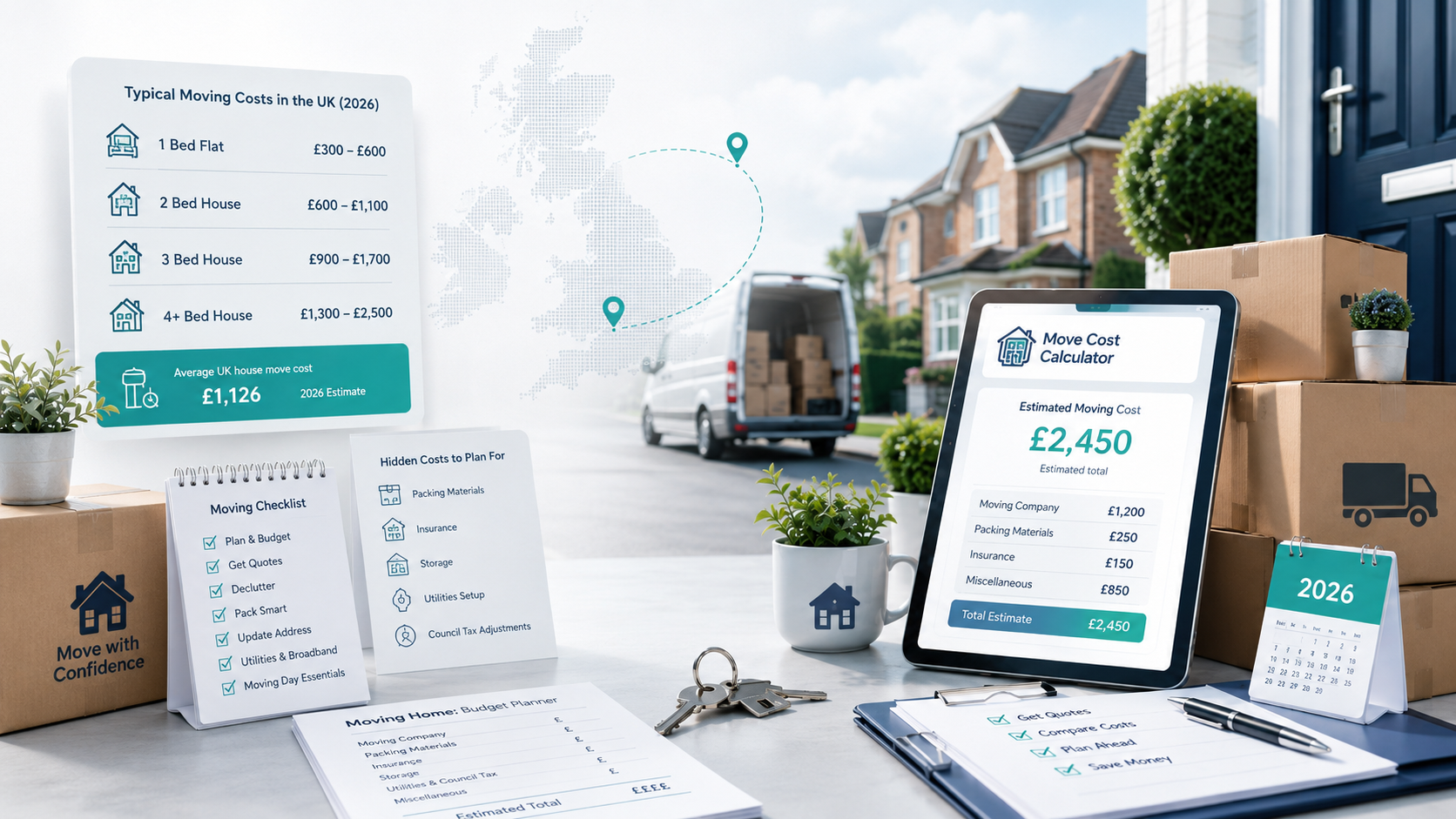
The average cost of moving house in the UK ranges from £800 to £2,500 depending on property size, distance, and whether you use professional packing services.
What affects removal company prices?
Key factors include the volume of your belongings, the distance of the move, ease of access (stairs, parking), and the time of year (weekends and summer are more expensive).
Are removal costs higher on weekends?
Yes, Fridays and Saturdays are the most popular days to move, meaning removal companies often charge a premium. Moving mid-week can save you up to 20%.
Can I reduce moving costs by comparing quotes?
Absolutely. We recommend comparing at least 3 local quotes from verified removal companies to ensure you get a fair market rate and avoid overpaying.
Ready to Estimate Your Moving Costs?
Use our free, AI-powered moving cost calculator to get an instant, accurate estimate for your UK house move. No hidden fees, just honest pricing.